
Quarterly Strategic Review - 2nd Quarter (Apr-Jun, 2026)
If I’ve learned anything through my 25+ years in the markets, it’s that they’re always changing, capable of shifting gears on a dime, they act and move in directions that surprise many who aren’t open-minded and demand a constant posture of humility. Strong convictions can lead to catastrophic losses and stubborn behaviour can be calamitous for our finances.
All the housing issues in Canada are growing and you likely already know my opinion on Canadian taxpayers bailing out Vancouver developers who find themselves stuck with inventory that “can’t be sold at market price”. Of course, those of us in the stock market know all too well, that market price is what someone is willing to pay you, not the high price you might be otherwise anchored to and real estate is no different. The truth is, interest rates have been holding steady at best, but ultimately trending upwards since the bottom in 2020 and the new homebuyers, who eagerly and aggressively participated in bidding wars in ’20-’22 are now experiencing some challenges. Unfortunately, some of these may be your kids or even your grandkids. Lessons are sometimes hard to learn, but they’re best learned when you’re young and have more time to recover from them.
I digress. I do love summertime and travelling is a joy of mine as there are so many things, and people and places to experience. I just had an incredible opportunity to spend time with a friend, mentor and fellow CFA/CMT charterholder and his family south of Boston and spent a trading day together with his team. Next week, I’m taking the kids on a Chicago & Milwaukee road trip and aside from visiting the American Girl store (a MUST for Eloise!), we’ll eat steaks, pizza, try the Milwaukee custard I’ve heard much about and plan to see some MLB baseball games.
Is the “Dollar” Falling or Rising?
Oil prices, which had been declining for years, perked up as the war with Iran was picked and while they also abruptly (and in volatile fashion) corrected in recent months, those prices do appear to be back on the rise and as I said at the time, appeared to be the start of an impulsive move higher. That means commodity prices are rising and with it, inflationary pressures, which means gas pump prices, but also food prices and so forth, which means the central banks might have to actually raise interest rates, despite their stated preference to drop them.
The Canadian dollar has been quite weak this quarter, falling from an early ’26 high around 74 cents to 70.4 cents (approximately -4.8%) at the end of June, perhaps “because” of the recession that Canada is in, but either way, affected by the demand and supply for those dollars. Remember that for a currency to fall, it means another currency must rise and while the purchasing power of our Canadian dollars indeed has been falling (that’s what inflation brings), that’s the same for the other currencies of the world. From an investment standpoint, we were positioned to benefit in our portfolios with more U.S./foreign holdings than Canada a quarter ago as I discussed then, but we sit differently now.
As the Canadian dollar has weakened, we’ve made adjustments so the risk doesn’t come at us the other way now, as it has reached a level whereby I won’t be surprised to see it strengthen. Our benchmark for the #AllINsync portfolio is 50/50% (Canada/U.S.) essentially and we’re now sitting around ~55% Canadian dollar exposure. Renewed strength would also “make sense” if commodity prices were to rise as I’ve suggested is happening. Either way, and at this point, the Canadian dollar bottomed in early 2025 right as fear about what the tariffs would mean to Canada took hold. NOTE: More Canadian exposure does not have to mean Canadian stock market exposure, as there are a number of ways to essentially hedge the currency via ETFs and/or CDRs (Canadian Depositary receipts) which are increasingly available and represent the big U.S. stocks that trade on the Toronto stock market.
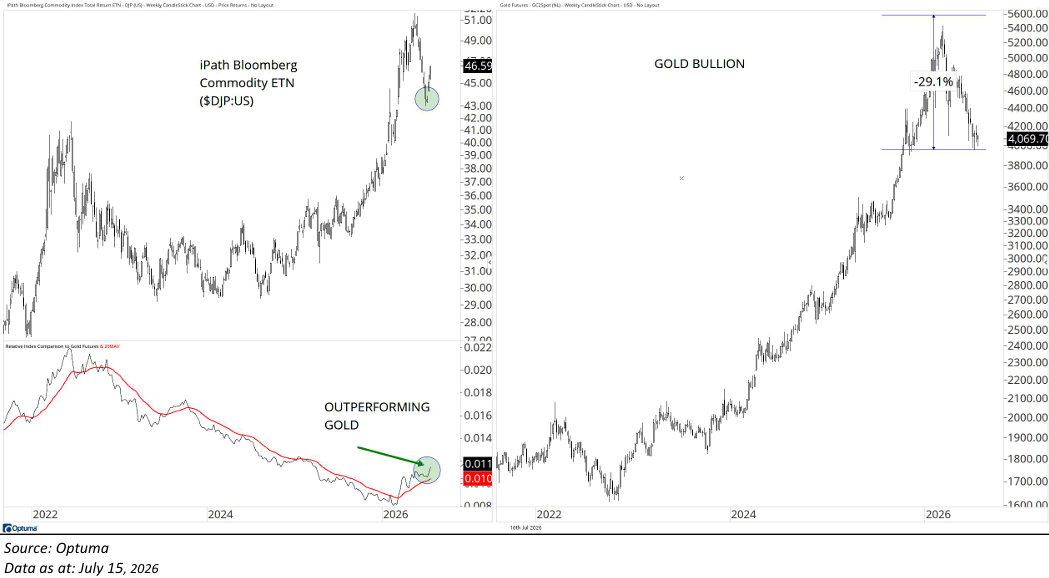
Here’s the chart of the iPath Commodity ETN ($DJP:US) that we recently bought after what I perceived as the first pullback against the uptrend. In the lower panel, we can see the relative trend vs. gold bullion. Notice that it has started to rise in recent months. That means that commodity prices, at the index level, are now outperforming gold for the first time in several years (gold is also in the index). On the right side of the chart, we can see the price of gold bullion itself, which rose strongly in recent years (and we all benefitted from this trend) and its recent -29.1% fall from its peak. While we took our profits for the most part (in January & March), we’ve shifted to the broader, more diverse commodity group recently to take advantage of the diversification that comes from buying/investing in assets with low correlation to other assets (remember David’s rule of diversification also tells us that when diversifying, we should diversify into assets that are also rising!). Exactly how I’ve described gold in the past. Side note: could we/will we buy gold again? Of course. IF it offers upside and diversification, we will have no hesitation re purchasing it in future months and/or years.
AllINsync (RJI237)
I struggle at times to communicate and write about strategy, which can quickly become outdated in a fast-moving market. The quarter itself was volatile, particularly June, whereby the semiconductor and artificial intelligence (AI) stocks gyrated significantly. It isn’t easy to stay with a trend and follow it, though I know it works. The issue (so often!) is what time frame does a trend maketh? There are short-term trends, intermediate-term trends and of course, long-term trends. Each time a stock (or market) peaks in the short-term, we have to be willing to accept that it could end up being part of a longer-term trend change, which of course would be even more important (especially in hindsight!). The semiconductor stocks were volatile in the short-term, but they ended the quarter on a strong note.
In the table below, you can see a variety of stocks that we hold and/or held and while they aren’t all semiconductor stocks (Rocket Lab is part of the space group!), I think this helps you understand what I’m trying to say. As I write this, these are the most recent peak to (current trough/low) for each of these stocks (through July 15th). Look at stocks like Netflix $NFLX (which was our top holding in #AllINsync at the end of April), Oracle $ORCL (our top holding at the end of May), and Lam Research $LRCX (our top holding at the end of June). It’s remarkable at times how sharply and speedily stocks fall and yet somehow, it never ceases to amaze me the power of markets. All three of these stocks were sold in all our accounts (after reaching their largest weighting!) and all three of them were sold for profits (despite the drawdowns shown).
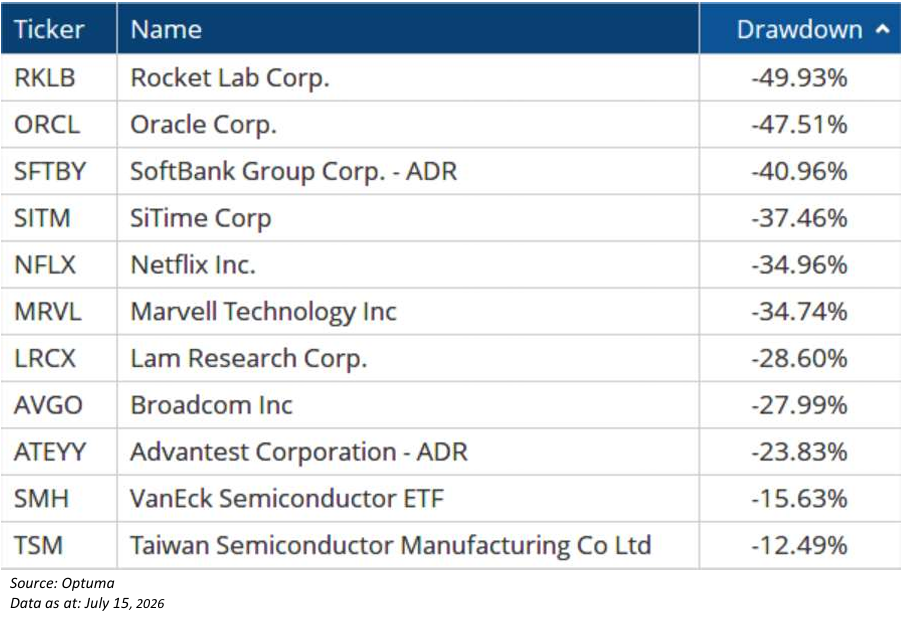
Volatility must be respected, always! Did we sell each of those stocks at their recent highs? No. Did we make every attempt to buy them at a sensible buy point, providing us with good reward: risk ratios? Yes. As I said, we sold them profitably, but that doesn’t mean we didn’t experience a loss of larger paper profits before they fell.
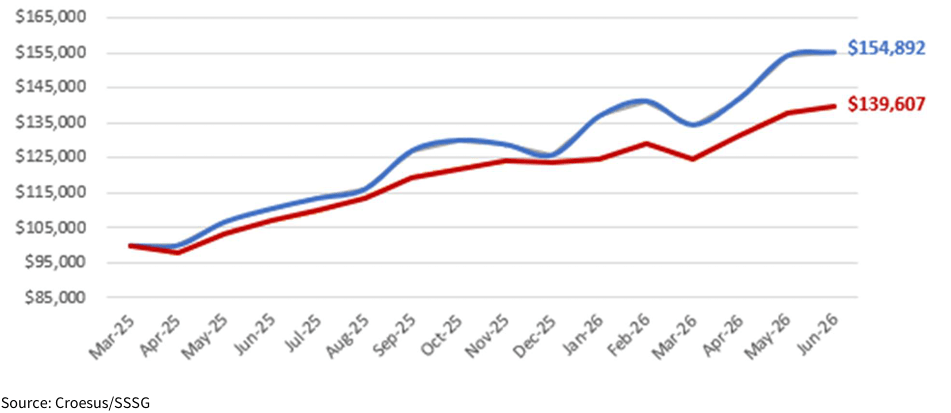
Here’s the updated chart of AllINsync vs. our 50/50 benchmark since March 31st, 2025 (after the initial rebalancing period) to the quarter-ended June 30th, 2026. The blue line is AllINsync vs. the 50/50 benchmark is red.
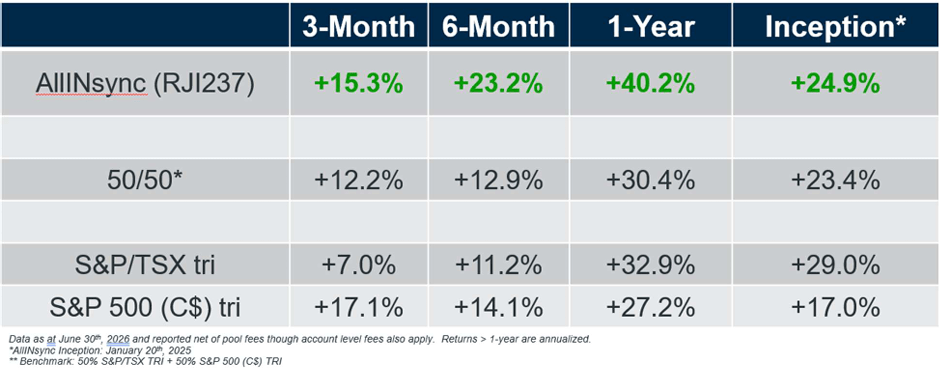
And here is the table of returns, also through June 30th, 2026 quarter end.
Our Strategy & Our Allocation
What about our non-AllINsync assets? There are a few of you that are non-Canadian residents and there are others of you, that hold AllINsync only for a portion of your assets (not 100%). Those of you that are more “balanced” in investing posture have trimmed equity holdings during the quarter after what has been a very strong period in recent years. We’ve also rebalanced our fixed income portfolio to shift toward corporate bonds and we own some preferred shares.
Given that most clients sold (and/or trimmed) their gold, silver and crypto ETFs ($BITQ/$BITS) earlier this year, those monies effectively have been redeployed more broadly into #AllINsync itself, which remains our primary investing vehicle.
For those that cannot hold AllINsync, the question becomes what can we do to effectively replicate the results, strategy and implementation of AllINsync? Firstly, given it’s ultimately the same decision-making process, it isn’t hard for me to struggle understanding how a few accounts can relatively lag so noticeably. Sure, there can be individual tax concerns that can change and/or have slowed down my decision-making, but ultimately, there are few reasons why the strategy cannot be better tracked in future. It is true that AllINsync is a regular user of options, that I find extremely valuable (though still not optimized for their capabilities), though are not practical to replicate outside of AllINsync. I expect we will shrink this gap in future, as we are striving to do.
We are always seeking to utilitze a cutting-edge investment process, a process which can adapt to changing market conditions and to the environment. I am confident that we can continue to work towards a more efficient, more model-like process for those accounts outside of AllINsync and/or for our U.S. clients (who also cannot hold AllINsync).
Similar to my comments last quarter, our focus sectors remain the same: technology, industrials, energy and materials although the latter two are trickier than tricky to handle. These cyclical stocks are volatile and erratic and don’t tend to trend for long. Uranium had been a strong theme, but those stocks have recently corrected materially and oil & gas stocks come and go with short-term bursts of strength. The gold/precious metals stocks, which make up most of the Canadian materials sector have been VERY weak as gold and silver bullion have fallen and then copper and steel. Again, it can be tough to have and/or maintain exposure to benefit without being subject to whipsaw.
One area that has no doubt been a bit of a sore spot is these Canadian banks. While last quarter I shared with you that we owned both CIBC ($CM) and National Bank ($NA), I can also admit that we sold them both for profits during the quarter, adapting to short-term price behaviour which did not end up leading (thus far) to any longer-term trend change and instead left us on the sidelines largely missing an incredibly strong industry group that has rallied in a low risk manner and could have (and should have!) benefitted us more than it did. That said, I’ve also pointed out, (while wearing my fundamental hat) that the persistent rally of Canadian bank stocks seems crazy given the low dividend yields that have resulted. This is VERY unusual to stay the least. Canadian bank yields haven’t been this low(!) since I’m not even sure when. We can currently get higher yields on money market than on bank stocks, which doesn’t tend to portray an environment where these prices keep rising.
Look at the last 10-years of the dividend yield for CIBC:

And today, it’s ($CM:TSX) is yielding only ~2.47%/year!! Remember, a dividend yield can rise through an increase in dividends (while price stagnates) or through a falling share price. Wild times we live in. But the trend is the trend, and we didn’t capture it like I wish we did and it looks (and feels) late, to try to get involved, but some of you would be right in saying that I myself, always point out that trends can carry on for far longer than we think reasonable and getting in the way of them with our own narratives or biases is dangerous. Again, a shortcoming in the past year for us, strategically.
A Few Reminders & Closing Thoughts
It’s summer-time and that means vacation time for each of us at Financially INsync (and surely some of you too!). I admit my schedule seems rather hectic at times, but in the next few months, I’ll be visiting Chicago/Milwaukee, Muskoka, Las Vegas, Florida and Peru. Geesh. I know it sounds a bit crazy! And that’s only through the start of September! Enjoy your summer! I’m excited and thankful that both Avery & Kieran are now licensed in their roles, which will continue to make my ultimate portfolio management responsibility easier to handle from afar or at a distance. Always understand that risk in our portfolios is always managed as (and when) necessary, not only when I happen to be sitting at the office in Waterloo!
Thanks for reading this quarterly strategic review and your questions and/or comments are always welcome!
Sincerely,
David Cox, CFA, CMT, FMA, FCSI, BMath
Senior Portfolio Manager, Wealth Advisor
Raymond James Ltd.
Phone: 519.883.6031
Unit 1 – 595 Parkside Drive | Waterloo, ON | N2L 0C7
www.financiallyinsync.com
 @DavidCoxRJ
Disclaimer: Information in this article is from sources believed to be reliable, however, we cannot represent that it is accurate or complete. It is provided as a general source of information and should not be considered personal investment advice or solicitation to buy or sell securities. The views are those of the author, Financially INsync Team, and not necessarily those of Raymond James Ltd. Investors considering any investment should consult with their Investment Advisor to ensure that it is suitable for the investor’s circumstances and risk tolerance before making any investment decision. Statistics, factual data and other information are from sources believed to be reliable, but accuracy cannot be guaranteed. It is furnished on the basis and understanding that Raymond James Ltd. is to be under no liability whatsoever in respect thereof. It is for information purposes only and is not to be construed as an offer or solicitation for the sale or purchase of securities.
Raymond James Ltd. is a Member Canadian Investor Protection Fund.
Raymond James (USA) Ltd. (RJLU) advisors may only conduct business with residents of the states and/or jurisdictions for which they are properly registered. Raymond James (USA) Ltd., member FINRA/SIPC.