
Quarterly INsync Chit Chat October 2026
A Rather Busy August! [by David Cox]
My two youngest kids had wanted to go to Florida for a while and so we did it! We also took my nephew Grady (13) with us too and we had a great time although it was crazy hot!

We got to swim in the Gulf of Mexico, which was surprisingly warm – so warm that we could have stayed in all day (no exaggeration!). The boys went parasailing, we all spotted dolphins on our boat tour and our VRBO had a pool and so lots of dips made for a week of fun! We saw the Blue Jays play the Tampa Bay Rays and even got to go see a pre-season NFL game (Buccaneers vs. Chiefs)!
And a day after we got back from Florida, the kids were off to a reunion and so dad (yours truly) went to Peru. Machu Picchu had been a bucket list item for decades and it really was special. The trek over the Salkantay Pass wasn’t easy and sleeping on a cold night in a tent at 4,100m left me feeling rather unwell the next morning and without being able to eat, I wasn’t sure I could make the 3-hour trek to the pass at 4,600m. But some great guides and fellow trekkers support and we all got there. Afterwards, I went to the Amazon for a few nights and it really is and was a spectacular! The Macaws and parrots were beautiful, the tarantulas were gross and there was lots in between! Amazing food and great culture in Peru!
News – Some That You’ve Heard, Most That You Haven’t - [by David Cox]
Canada’s GDP per capita, at about US$55.7k, is now below Mississippi’s (about US$55.9k) which puts Canada under every US state. The Canadian recession that wasn’t: Q2 GDP grew 3.3% annualized (the fastest since 2023) and Q1 was revised up to +0.3%, so Canada was never in a technical recession after all. China's U.S. Treasury holdings hit an 18-year low. The U.S. and Japan jointly intervened to prop up the yen. Consumer insolvencies keep climbing, especially in B.C. and Ontario 145,681 filings in the 12 months to July, +5.4% y/y. B.C. is +14.1% and Ontario +8.2%, while Ontario mortgage arrears rose from 0.27% to 0.33% (Dec–Jun). Corrections Canada to distribute items for “safe snorting” in federal prisons. Canada wants off Starlink (it’s a U.S. company) – but its alternative rides on SpaceX rocket. PM Carney said Canada will “diversify away” from Musk’s Starlink in favour of Telesat’s network. Ottawa awarded Telesat (whose CEO is a long-time friend of Carney) a $2.3 billion contract to secure military Arctic connectivity – and those Telesat satellites will be launched by SpaceX (it’s a U.S. company) – did you follow that?
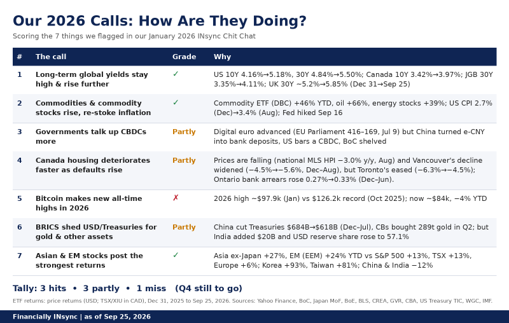
2026: How Are Our Calls Doing? [by David Cox]
You know I'm not a fan of forecasts. Our process follows supply & demand, not predictions. Still, in our January 2026 INsync Chit Chat I listed seven things I thought could matter in 2026, and it's only fair to check them honestly with a quarter left. Some are playing out, a few are mixed (Canadian housing is hurting regionally, not nationally), and one (Bitcoin) has been a clear miss so far. I own that.
Book Corner [by David Cox]
Almost 15 years ago, I had the pleasure of meeting Peter Robbins at the monthly Oakville Canadian Society of Technical Analysts (CSTA) meeting and always enjoyed chatting markets, charts and investment strategy every month for several years.
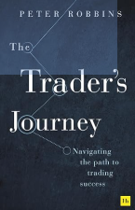
Peter later became widely followed on social media with 135K followers on X. He recently wrote a book that is very approachable for aspiring and seasoned traders and investors alike. His experience lends well to pointing out the potential shortcomings in an investment strategy, the biases we have and the varying components of how to build an investment process.
It was an easy read for me, but I’d suggest a worthwhile investment of time for anyone that is on the road to investing success. Peter’s insatiable pursuit of ideas and commitment to never-ending learning is something we both share. Check it out!
Wellness Wins! - [by Avery Kelly]
One of my favorite additions to my nighttime routine has been my red-light therapy mask. I use it for about 10 minutes before bed, and it’s become a really easy way to wind down while doing something good for my skin.
I find it helps calm the inflammation and redness in my face, and my skin generally feels softer and looks healthier when I’m using it consistently.
Red light therapy also isn’t completely new to me. When I was playing volleyball and training at university, we would use red light therapy when dealing with injuries as a way to support recovery for a particular area of the body. When I started seeing the same general technology being used in skincare, I was naturally interested in giving it a try.


There is some interesting science behind it too. Research into red and near-infrared light has found potential benefits for things like collagen production, blood circulation, and reducing inflammation, which helps explain why the technology has become increasingly popular in skincare.
That said, the biggest reason I keep using it is simply because I like how my skin looks and feels. It takes 10 minutes, requires basically no effort, and fits perfectly into my routine before bed. I’m not saying it’s a miracle skincare solution, but it’s one of those little things I’ve tried that I’ve actually stuck with.
If you’re interested in giving it a try, there are a variety of masks on the market that work in a similar way! [DAVID’S QUESTION: Avery, would you answer the door with the mask on?]
How’s the (Bigger Picture) Market? [by David Cox]
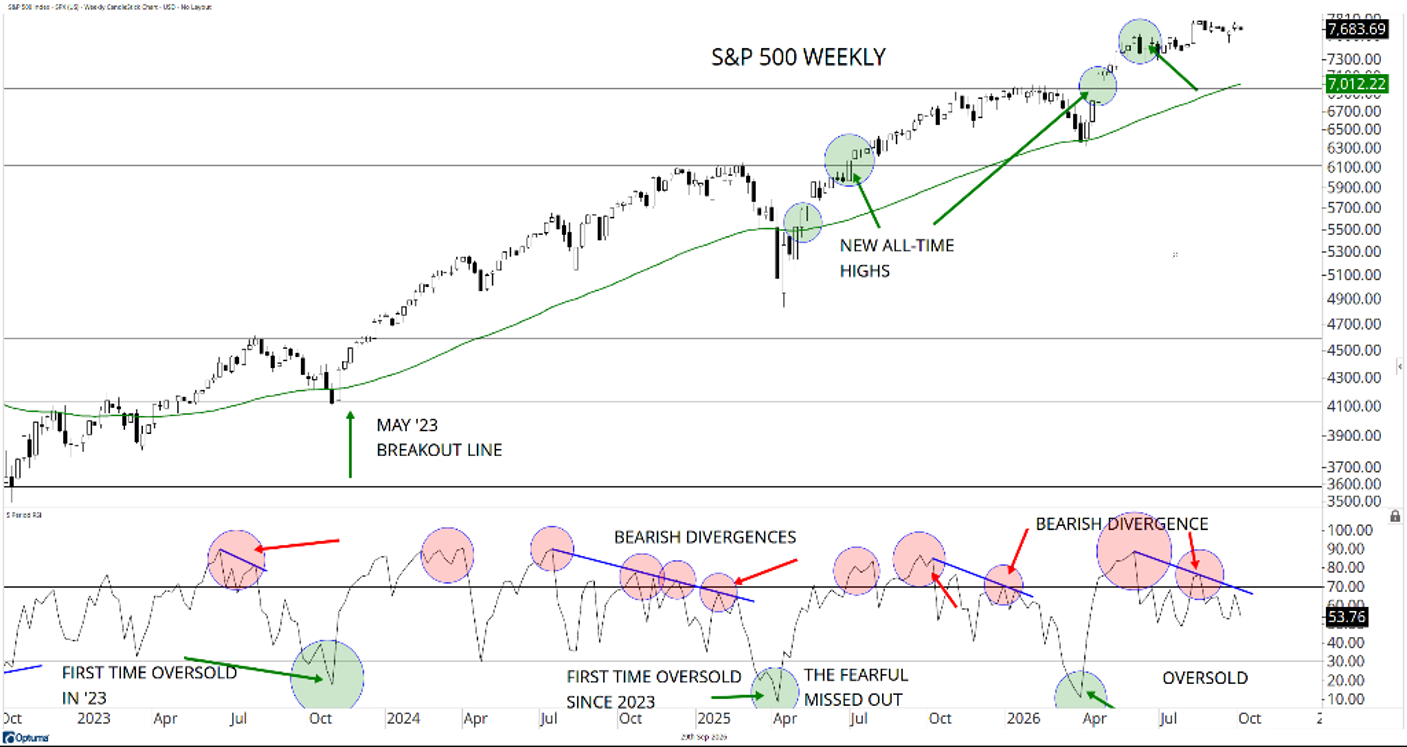
I think it’s fair to say that if you only looked at the headlines and news, you’d have no clue that the U.S. stock market looks as steady as it does (see chart below). Despite the day-to-day swings and fears that ebb and flow, the trend is the trend and the big picture continues to point upwards. Perhaps even more impressively is that despite surging bond yields and commodity prices, the equity market remains in its uptrend.
To balance the view, I’ll definitely acknowledge that the breadth of the market (the number of stocks that are rising within it) continues to deteriorate, not necessarily in a troublesome way, but it’s a flag on the field that we’ll be continuing to assess carefully. In 2021, the market continued to rise while breadth deteriorated all year long and that is NOT the situation we face in late ’26.
There was a bearish divergence on the S&P weekly chart as the RSI(5) in the bottom panel made lower highs while price rose in recent months and that too, is information, but not the kind of information that would cause us to action our portfolios. We take in all of it in effort towards striving for an ongoing #marketpulse and to be ready to adjust to changing conditions.
Things We Recommend - [by Avery Kelly]
With all the talk about artificial intelligence, bots, agents, and more, sometimes I find it difficult to discern which new technology tools will actually make a difference in my day-to-day life.
One unique tool I find myself using almost every day is Google’s “Search by Image.” This allows you to upload a screenshot of whatever you’re looking at and have Google identify it, provide more information, find the original source, suggest similar items, and much more!
For example, I saw an image of a brown sweater posted on social media last week. I wanted to know where the product was from and how I could purchase it. I uploaded a screenshot to Google and was provided with the product name, company, and a link to purchase it. Additionally, if the item had been out of stock, Google could have helped me find similar options.


This tool can be great for finding products, recognizing landmarks, translating text, discovering the original sources of artwork, or even finding inspiration that aligns with a design or style you like.
It’s a simple tool to use and has been around since 2011 (crazy!), but it continues to prove incredibly useful!
Artificial Intelligence -> Human Wisdom? [by David Cox]
I’d heard about AI “agents” and that they could conduct workflow making lives more efficient but suddenly, I have a team of Grok @bots working for me for the past couple of weeks! Honestly, I’m shocked. Here are a few things they can do for me: provide market insights/risk levels, make my weekly market journal entry easier, check the fine print, let us know about earnings, help to streamline our social media routines and more. I can record small routines like going to a certain website for data and/or screening and they can replicate it on a schedule and even send me the results. They’re willing to work 24/7 and I just had them meet amongst themselves this past weekend to better coordinate all the goings on in (my) life, inside and outside the office! I have a busy schedule and having my “Chief of Staff” go to the website of Emry’s hockey and put in all the practices and games (and their locations) sure is nice to have happen for me!
But AI doesn’t make investment decisions. Our process, our stops, and our judgement are still ours, it just offers the opportunity to regain some time to focus on them (and on you!).
What Are We Buying? Selling? Holding… [by David Cox]
Gold, six months later. In April I wrote that gold "just peaked," and we sold our gold & silver bullion positions in #AllINsync. I also said I wouldn't be surprised to see gold consolidate and "even move back down to the $3,000s." So how did that go? Gold's closing high was ~$5,318 on January 29th (the intraday high was just shy of $5,600). By the end of March (when the April charts were drawn) it was ~$4,526. It then slid to a closing low of ~$3,992 on July 16th (~$3,955 intraday on June 30th), so into the $3,000s for about a day or two, just barely! It bounced to ~$4,660 in late August and has since rolled over again: ~$4,180 at the September 29th close, roughly flat YTD and ~-25% from the peak. The "central banks are buying everything" narrative took a hit when the World Gold Council revised its Q1 central bank buying down from 244 to 57 tonnes. We have some exposure again, but it’s not adding value (yet).
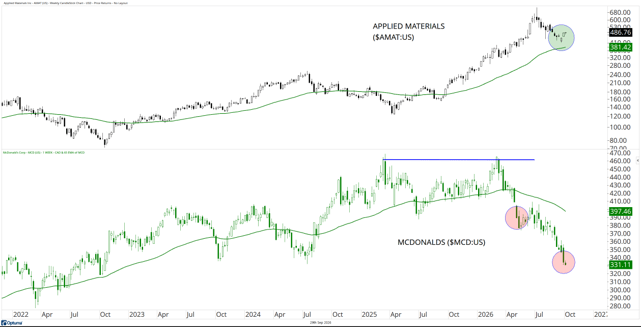
Technology & semiconductors: leaning in. We added to Microsoft ($MSFT) and acquired a new position in Applied Materials ($AMAT). AMAT is ~30% below its June 30th high ($723 → ~$509) and off its rising 200-day average and is +89% YTD. That's a pullback inside a long-term uptrend, and so the risk/reward justified a new position in September. The semiconductor index as a whole is -11% this quarter but remains above its 200-day. Volatility is the price of admission here. I discussed $AMAT on my recent BNN appearance on “Market Call” – it’s available here: Trading Day for Monday, Sept. 28, 2026.
Market Summary and Trend of “All Assets” - [by David Cox]
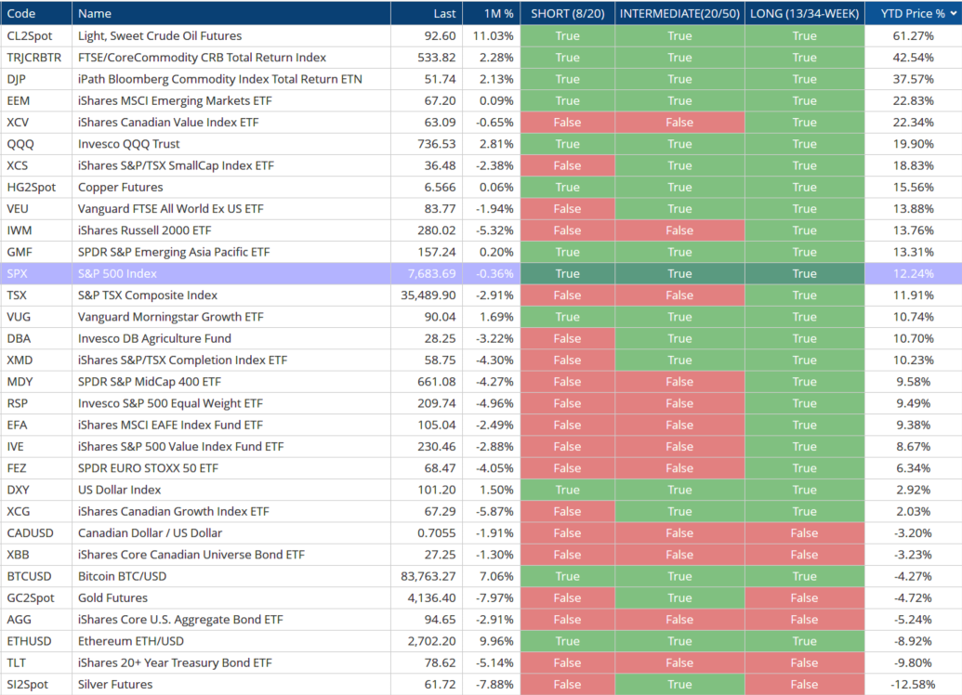
While crude oil leads the list and certainly captures headlines these days ever since the U.S. and Israel attacked Iran, the truth is, that crude oil prices are still below the ’22 highs. That said, the chart of U.S. strategic petroleum reserve looks like a strong downtrend and with the U.S. exhausting its reserves to keep prices from exploding, I suppose we have to wonder what will happen when this supply is no longer.
Commodities have been outperforming stocks, and those rising input costs (think copper, grains, energy and so forth) typically lead to inflation and perhaps that but one of many reasons the bond market continues to sell off and the inversely correlated yields continue to rise. While the Toronto stock market outperformed over the past 12-24 months, it sure hasn’t been consistent and at this point, I’d say I don’t expect it to continue. Why? Because the charts do not show a relative uptrend (yet) – if commodities to continue to surge, it’s possible it could take a real power position over the U.S., but U.S. technology/artificial intelligence/semiconductors continue to be a much more powerful trend and the S&P 500 is well endowed with technology exposure (~37.9%!).
 Source: Optuma
* as at September 28th, 2026
One Uptrend, One DOWNtrend - [by David Cox]
As I alluded to earlier, we recently bought into the pullback in Applied Materials ($AMAT) and when you look at our most basis checklist, you can see the idea of absolute + relative trend.
Stock is in an uptrend ☑
Stock is in a strong/focus sector ☑
Stock is in a strong industry group ☑
To contrast that with a company that everyone knows well, we compare McDonalds ($MCD). This isn’t one that we’ve owned, but it is worth pointing out the different character. No matter whether you consider it a consumer staple in your life (something you have all the time) or a consumer discretionary business (it’s a treat(?)), it (the stock) peaked. And both of the consumer sectors have been weak sectors vs. the markets themselves. We don’t try to make sense of why a stock goes into freefall, but you know me, instead, I prefer to spot trend changes and want us to stay on the right side of them (in this case, that means looking at it for educational purposes only).
Source: Optuma
* as at September 28th, 2026
Getting AllINsync - Beyond the Basics (of Estate Planning) [by Kieran O’Donnell]
Estate planning often brings to mind your will, executors and powers of attorney. While these documents play a vital role, beneficiary designations are sometimes overlooked during the estate planning process. However, these designations can have a significant impact on how assets are transferred after your passing.
Contingent Beneficiaries – Naming a primary beneficiary is important, but it’s equally important to consider what happens if that person passes away before you or at the same time. A contingent beneficiary acts as a backup plan and helps ensure your assets are distributed according to your wishes rather than being redirected through your estate or creating unnecessary complications. In addition to helping maintain your intended distribution plan, properly designated beneficiaries may also help certain assets avoid probate, reducing delays and simplifying the transfer process for loved ones. Contingent beneficiaries need to be reviewed just as often as primary beneficiaries especially if they have never been considered or added.
Considerations for Minor Children – While it may seem straightforward to name a child or grandchild as a beneficiary, doing so can create additional legal and administrative complexities. In many cases, a minor cannot directly manage inherited assets until they reach the age of majority where they live. Taking the time to consider how and when funds should be managed on a child’s behalf can help provide greater flexibility, protection and oversight until they are ready to assume responsibility for those assets.
Understanding the Tax Implications – A beneficiary designation can simplify the transfer of assets, but it does not always eliminate tax obligations. Depending on the type of assets involved, taxes may still be payable upon death. Understanding how registered accounts may be taxed upon death can help avoid surprises and ensure your overall estate plan remains effective. Proper planning can also help beneficiaries better understand what to expect and reduce the likelihood of unforeseen tax consequences.
As life circumstances change, it can be beneficial to periodically review beneficiary designations to ensure they continue to reflect your current wishes. Events such as marriage, divorce, the birth of a child or grandchild, retirement or the loss of a loved one are all good opportunities to revisit your designations. While beneficiary designations may seem like small details, they can play an important role in the timely and efficient transfer of assets. A simple review today may help avoid complications, delays and unintended outcomes for your loved ones in the future.
The Narrative is Wrong - [by David Cox]
Canada has experienced a massive wave of population growth via immigration over the past 10 years (much more quickly in the past five!). As our economy has grown, it has failed to grow on a per capita basis (meaning per person) and I think it’s easy to argue that the growth has been partly responsible for the inflation that we’ve all experienced. It’s not too hard to understand that more and more people buying the same things and seeking the same jobs leads to higher prices and less job availability.
We’re now being told that “population growth has slowed to the lowest level in years” at +0.5% in the past year. At the surface, many Canadians read this and think the trends have reversed, but not so fast! Just like when we hear them tell us that inflation is slowing (or falling), it’s simply not true. A growth number, i.e., +0.5% is still a growth number and so when population has risen by 5-6 million people over the past 10-years and now our overall population is only growing by +0.5% it’s still getting larger! I might dig into this more in an upcoming blog for the “INsync Angle”.
AllINsync: How Are We Exposed? [by David Cox]
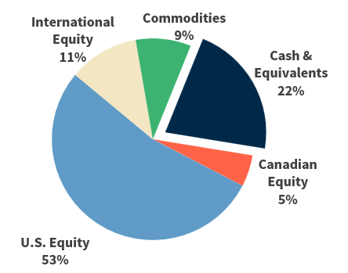
We continue to sit with technology representing a substantial part of the #AllINsync portfolio. And that means U.S. stocks! As I said, the U.S. technology sector is a huge component of the S&P 500 (~38%) and that means to have much less, you’re betting against it (at least in the terms of the way we like to look at a stock market as proxy for expectations. Which by the way, is not always fair or reasonable as we do have differing objectives and risk tolerances.
Technology stocks tend to be more volatile and I don’t need to provide more proof of that than July, 2026, when #AllINsync fell dramatically as the relative strength leaders fell very precipitously through the lows on July 29th. True, it wasn’t all technology, even stocks like Caterpillar were crushed (since sold) but it is a fact. Semiconductors, which have been a leading and outperforming industry group are known as a volatile bunch!
Here’s how we’re positioned as the 3rd quarter wraps up!
Source: Croesus, Factset
* as at September 28th, 2026
Chart of the Month - [by David Cox]
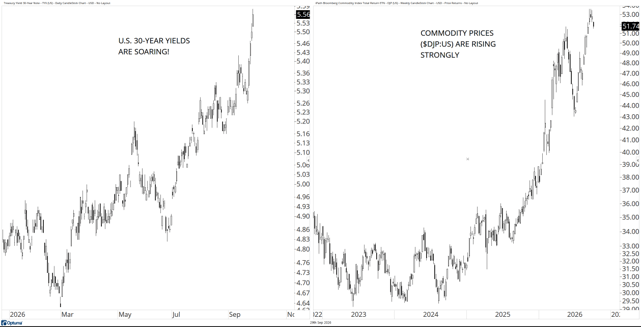
I thought it necessary to put the rising yields in focus this month because this really is a strong move! 30-year U.S. yields have gone up by almost +1% from the ’26 lows and this is significant! Yields have been rising around the globe, so don’t mistake this for a U.S. phenomenon.
And commodity prices are definitely strong too, and so the desire for many to have borrowing costs remain low is suspect. The Federal Reserve recently raised interest rates and this can attract interest to a currency and since then, the Canadian dollar has been falling most days. A falling Canadian dollar is inflationary as the costs of these commodities and the goods we buy rise in price, which puts the Bank of Canada into decision-mode. Will they raise rates to follow? The Canadian economy is far more dependent on housing than the U.S. and so this would likely cause other issues yet to be seen…
 Source: Optuma
* as at September 28th, 2026
Sharing Our Tools of the Trade - [by David Cox]
There is never a shortage of learning in my role and as I’ve sought to better develop and manage our options exposure in the #AllINsync portfolio, and I’ve recently subscribed to ORATS. It’s not a cheap subscription but it appears to have a full suite of tools related to option backtesting, screening and analyzing. Who said that buying 20 delta calls on a 4-5 week basis is wise? I’ve always been a fan of using real data to test strategies, but ORATS offers the opportunity to better optimize our strategy in pursuit of higher expected returns which in options parlay, could mean a higher win rate and/or larger win vs. loss ratio.
We Like Fundamentals Too - [by David Cox]
Most of us have a computer (or two, or more!) at home and I’m sure we can also admit to other devices like phones and smart TVs. Nearly all of these devices need two kinds of chips: memory (DRAM), which is the fast working space a device uses while it’s running, and storage (NAND flash, or on older or bigger systems, hard drives), which is where your photos live when the power is off.
With the incessant demand from the rapidly growing artificial intelligence space, the price of memory chips has soared, and storage chips have followed. Who makes them? In DRAM the big three are Samsung, SK Hynix and Micron, and in flash storage you’ll see those same names plus Kioxia and Sandisk. Micron ($MU) is the one large memory maker in the U.S. and we own it.
Social Media and Our Website - [by David Cox]
If you’re not already following along on X, you can find me at @DavidCoxRJ, where I regularly post charts and market observations most market days. Engagement keeps growing, with more than 339K impressions in the past month!
Our YouTube channel is now live at https://youtube.com/@financiallyinsync_rjl You'll find our weekly Friday "Where Do We (Investors) Stand?" webinars there, along with my BNN segments and other media/podcasts, and more original content is on the way! Please subscribe so you don't miss anything!
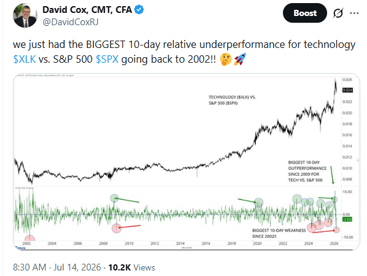
A few of this quarter’s most popular posts are below:
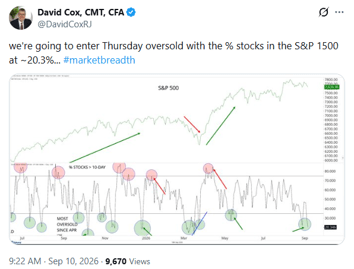
As always, past issues of our quarterly “INsync” Chit Chat and our other thoughts are available on our website https://www.financiallyinsync.com/ under the “We Communicate” tab…
Upcoming Dates, Seminars, and Announcements - [by David Cox]
I’m very excited to announce that Avery Kelly is newly licensed as a Registered Representative (RR) and her title is Wealth Advisor Associate! And, Kieran O’Donnell is licensed as an Investment Representative (IR) and is our Client Service Specialist! Please join me in congratulating both Avery & Kieran on their recent coursework and progress! Avery has already enrolled in her next course, “Investment Management Techniques” as she follows the path to an eventual Portfolio Manager designation.
What: “CMT Fall Summit”
Where: Bethesda, MD
When: October 1-2nd, 2026
Who: I will be making a presentation entitled “Know Your Risk Before The Market Tests It…”
What: “International Federation of Technical Analysts (IFTA) 2026 Conference”
Where: London, UK
When: October 9-10th, 2026
Who: This will be my second IFTA conference, the last was when I spoke in Hainan, China.
What: “Raymond James National Business Conference”
Where: Montreal, QC
When: October 20-23rd, 2026
Who: This is always a motivating, thought provoking opportunity to gather new ideas, network with fellow PMs and to learn!
The colours on the trees have started to change here in Ontario and I wish you all a lovely fall season! Your questions, comments and/or feedback of any kind is always welcome!
Regards,
David Cox, CFA, CMT, FMA, FCSI, BMath
Senior Portfolio Manager, Wealth Advisor
Raymond James Ltd.
Phone: 519.883.6031
Unit 1 – 595 Parkside Drive | Waterloo, ON | N2L 0C7
david.cox@raymondjames.ca
www.financiallyinsync.com  @DavidCoxRJ